
Thermal insulation in brewery construction: energy efficiency from the brewhouse to the storage tank
Thermal insulation in brewery construction is one of the most demanding disciplines in industrial insulation. From the brew kettle to the storage tank, every point has its own requirements for temperature, hygiene and choice of material.
Tradition and modern requirements in brewery construction
Breweries have been working with sensitive temperatures and strict hygiene requirements for centuries. The mash tun operates between 65 and 78 °C, the wort is boiled at around 100 °C, and after the whirlpool rest it has to be cooled down abruptly to 8-12 °C without wasting energy.
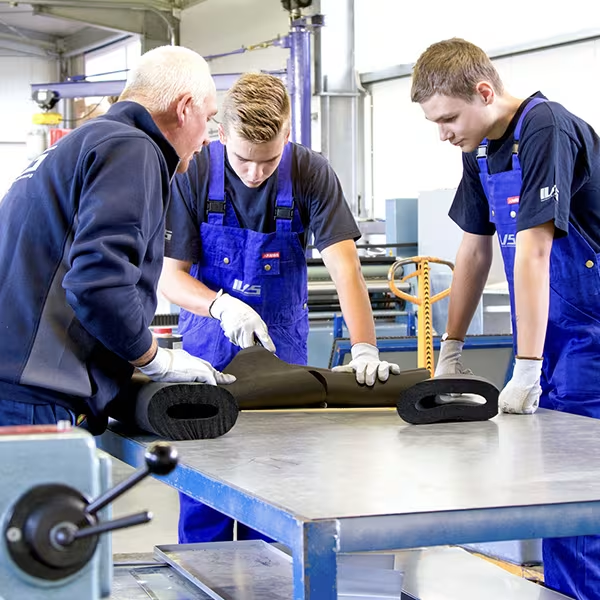
This range calls for well thought-out insulation systems: mineral wool with high temperature resistance for the hot area, closed-cell foams against condensation on cold lines, food-grade cladding sheet and chemically resistant surfaces. IVS has been planning these combinations together with brewery engineers for more than three decades, from the small brewhouse to the industrial brewery.
Which areas of a brewery need insulation?
Four main zones appear in every project:
- Brew kettle and mash tun, hot area up to 100 °C
- Wort cooling and whirlpool, rapid cooling section
- Storage and pressure tanks, cold area down to −2 °C
- Pipework for wort, beer and cleaning agents
Choice of material by temperature zone
The choice of material decides how energy efficiency and hygiene can be reconciled. In the brewhouse, mineral wool systems with high temperature resistance keep the hot area at operating temperature without heat being lost to the air in the hall. In the tank farm, by contrast, closed-cell PUR rigid foams with a gap-free vapour barrier prevent condensate from running onto the cold cladding and damaging the plant technology in the long term. This combination of heat protection, cold protection and hygiene requirements makes brewery insulation a field of its own.
Choice of material at a glance
| Zone | Insulation material | Cladding material |
|---|---|---|
| Brewhouse / hot area | Mineral wool, thermal conductivity group 040 | Stainless steel sheet 0.6 mm |
| Tank farm / cold area | PUR rigid foam | Aluminium jacket + PVC |
| Wort line | Mineral wool + elastomer | Hygienic stainless steel V2A |
Energy efficiency: what pays off for breweries
Professionally executed thermal insulation in brewery construction pays off measurably. On well insulated brew kettles the heat loss to the air in the hall typically falls by 60 to 80 per cent: less steam per brew, noticeably lower energy costs. In the tank farm, continuous cold insulation reduces the electricity demand of the refrigeration plant, because the storage tanks have to work less against the ambient heat.
On top of that come benefits that cannot be read directly from the electricity bill: more even process temperatures, fewer thermal stresses at welds, better sound insulation on noisy CIP pumps and CO₂ recovery units. For most breweries the investment in modern insulation systems pays for itself within two to four heating seasons and then delivers decades of reliable operation. Energy efficiency and plant safety thus go hand in hand.
IVS has been planning and installing thermal insulation for breweries of every size for over 40 years, from the regional family business to the industrial brewery. With our own V2A/V4A prefabrication and installation teams that also work during ongoing shift operation, IVS covers the entire spectrum: from a maintenance job on a single brew kettle to the complete renewal of cold and thermal insulation in the tank farm.
Conclusion: thermal insulation as an economic factor
Thermal insulation in brewery construction is today no longer only a question of energy efficiency, but also of plant availability, product quality and occupational safety. Anyone who consistently insulates the brewhouse, the wort lines, the lager cellar and the tank farm not only reduces heating and cooling costs but also minimises condensation, protects stainless steel surfaces from corrosion and stabilises temperature control across the entire process chain. Breweries that renew their insulation systematically report measurable efficiency gains and calmer process control throughout the season.
Anyone planning to modernise or build a brewery should plan the thermal insulation in from the start rather than treating it as an afterthought. That way insulation thicknesses, cladding materials and maintenance hatches can be matched optimally to the plant technology, without later adjustments or compromises. Experience shows that involving the insulation specialist early in the planning phase saves effort later and leads to a considerably cleaner overall result.